
Recreation.gov is one of the main tools travelers use to book campsites, apply for permits, and reserve timed-entry passes on federal lands. Here’s what the platform does well, where it has limits, and how to use it more effectively when planning a public lands trip.
Recreation.gov is the federal government’s centralized travel planning and reservation platform. It currently supports 14 federal agencies and lists more than 103,000 campsites across 3,600-plus federal recreation areas, along with permits, tickets, lotteries, cabins, and day-use reservations.
What Is Recreation.gov?
At its most basic, Recreation.gov is a reservation hub for many federally managed outdoor sites and activities. That includes campgrounds, cabins, picnic shelters, permits, tours, lotteries, and some timed-entry reservations. It is used by agencies including the National Park Service, U.S. Forest Service, U.S. Fish and Wildlife Service, Bureau of Land Management, Bureau of Reclamation, and U.S. Army Corps of Engineers, among others.
Why People Use Recreation.gov
The biggest strength of Recreation.gov is that everything related to Federal lands and reservations on a single website. RVers can search for campsites, permits, tickets, and passes without leaving the site.
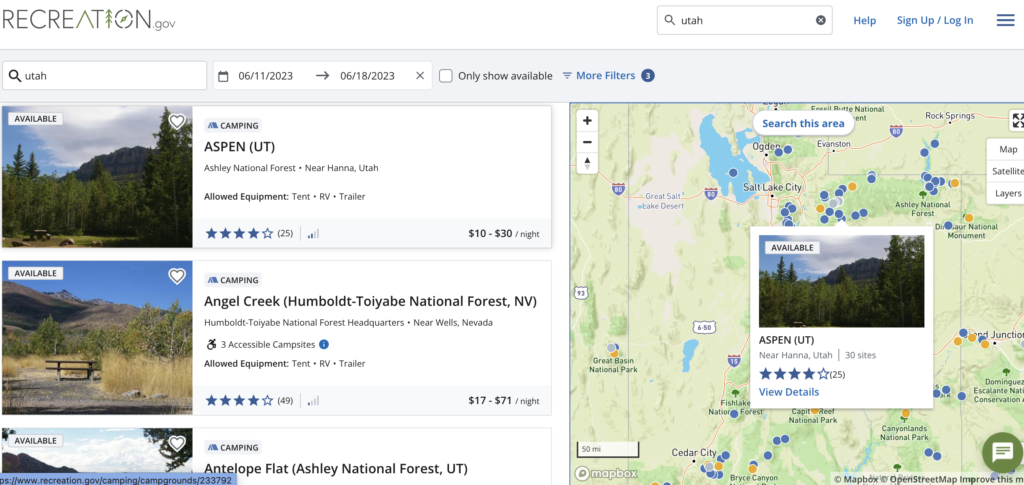
It is also useful for trip planning even before you are ready to book. A broad search can show camping options in national parks, national forests, and Army Corps of Engineers areas that may not be on your radar yet. The filters make it easier to narrow results by equipment type, site features, and amenities which is a big bonus, especially for those who RV with a larger rig.
There can also be savings for some travelers. Recreation.gov sells America the Beautiful passes, and the site notes that Senior and Access passes may provide discounts on some expanded amenity fees, including camping fees. But like all things related to the Government, the National Park passes can be incredibly confusing and constantly changing.
For a full overview of what is offered and what you may qualify for, check out our National Park and Federal Land Passes Explained for 2026 Video.
Tips for Finding Campsites on Recreation.gov
A good way to use Recreation.gov is to think bigger than one famous campground. Searching by state, region, or nearby town can open up a wider list of public camping options, including places managed outside the national park system.
The calendar and map tools are also helpful. They make it easier to spot openings across a range of dates and compare nearby options without checking each campground one by one. If your schedule is flexible, that can make a big difference too.
If you are traveling in an RV, pay close attention to site length filters, campground notes, and photos; ; those are your best friends. Recreation.gov does let users search for RV-compatible sites, but site descriptions still matter.
A site may technically fit your rig on paper, but it doesn’t take into consideration road layout, slope, or obstacles. We recommend checking Google Earth when possible and also using this handy site checking tool when in doubt. This part is less about the platform itself and more about using the listing details carefully.
It is also worth looking at your past reservations in the Recreation.gov app. The app lets users quickly review location details and access past and upcoming reservations, which can be useful if you are trying to remember a campground you liked on a previous trip.
Is Recreation.gov Just for RVers?
No. Recreation.gov is not just for RV camping.
Tent campers use it, cabin travelers use it, and many hikers and park visitors use it for permits, lotteries, and timed-entry reservations. Recreation.gov’s lottery system is used for some high-demand experiences, like popular hikes such as Angel’s Landing in Zion National Park.
Timed-entry needs can change from park to park and from year to year, so travelers should always check the specific park page before a trip. For example, Yosemite National Park says a reservation is not required to enter the park in 2026, which is a good reminder that these policies are not static. Does that mean the park will be less crowded? No. It does mean you will need to plan differently than in the past several years.
Is the Recreation.gov App Worth Having?
For many travelers, yes.
The Recreation.gov mobile app lets users find and reserve campsites, review location details, and quickly access information on past and upcoming reservations. That makes it useful both for long-range planning and for checking details while already on the road.
It will not solve every booking headache, but it is a practical tool to have when travel plans are shifting or when you want quick access to reservation information without logging in from a laptop.
Can You Book Concessionaire-Run Lodging on Recreation.gov?
Not always.
Recreation.gov is a federal reservation platform, but not every lodging property or activity inside a national park is booked there. Some services are run by third-party concessionaires and have to be reserved through those operators directly.
For example, in Yosemite National Park, the Ahwahnee can only be booked through Aramark, a private concessionaire that operates the hotel, while Lower Pines Campground is run by the National Park Service and booked through Recreation.gov.
The Bottom Line
Recreation.gov is a useful planning and booking tool for public lands travel, but it works best when you understand what it is and what it is not.
It is a strong starting point for finding federal campgrounds, permits, and reservations in one place. But it is not a catch-all for every lodging option or every service connected to a national park. Used thoughtfully, it can make planning a lot easier without replacing the need to double-check the details on individual park or campground listings.








Leave a Reply
You must be logged in to post a comment.