
Article Overview
- Lippert and Patrick Industries have revived their merger plans after earlier talks collapsed this spring.
- If approved, the deal would create one of the most powerful supplier groups the RV industry has ever seen.
- The combined company would touch many critical parts of RV manufacturing, from components and interiors to chassis systems, materials, and aftermarket products.
- Senator Mike Lee had already raised antitrust concerns about the potential merger before the companies reached a formal agreement.
- The central question is whether the deal will create efficiencies for manufacturers and RV buyers — or give one supplier too much control over the RV supply chain.
Two of the Biggest Suppliers, One Company
Two of the RV industry’s largest suppliers are moving forward with a merger, reviving serious concerns about how much control a combined company could have over the RV manufacturing supply chain.
Patrick Industries and LCI Industries (the parent company of Lippert) announced Tuesday that they have entered into a definitive agreement to combine in an all-stock merger. Together, the two companies, through their many subsidiaries, touch an enormous share of the RV supply chain, including components, chassis systems, furniture, countertops, electrical and plumbing products, trim, panels, and other materials manufacturers use to assemble RVs. A combined company would have extraordinary influence over RV manufacturing.
Earlier this year, the companies confirmed they were discussing a possible “merger of equals,” then announced on May 4 that those talks had been terminated after the two sides could not agree on certain key terms. At the time, the companies said there was consensus on the leadership of the combined company and other major aspects of the potential deal, but no agreement was reached.
A month later, LCI announced that Jason Lippert would step down as president and CEO, effective immediately, ending decades of Lippert family leadership at the company that bears his name. Now, the deal is back on, pending shareholder and regulatory approval.

A Huge New Supplier
Patrick and Lippert are not the only suppliers in the RV industry, but they are separately the two largest. Companies such as Dometic, MORryde, Dexter, and others play major roles in appliances, climate systems, awnings, suspensions, running gear, and other categories. But Patrick and Lippert differ in breadth. Both have spent years growing through acquisitions, adding brands, categories, and manufacturing capacity across the RV supply chain. Patrick is home to more than 85 brands, most of which are not public-facing. They’re flooring and sealant suppliers that most RVers haven’t heard of. Lippert is a more consumer-forward global supplier of components, leveraging the Lippert brand for both parts and consumer products as well as its major subsidiaries Furrion and Curt. Both also have a large footprint in the marine and manufactured housing industries.
Beyond their substantial overlapping products that currently compete with each other, Lippert is the largest supplier of trailer chassis in the world, and Patrick brings to the table lumber supplies and RV transport, which would mean that a merger could consolidate control of market supply from the beginning of an RV’s assembly up until it is delivered to the dealer.
According to the most recent quarterly earnings reports, Lippert supplies $5,826 in parts per travel trailer sold and $3,970 per motorized RV. Patrick supplies, on average, $5,277 of product per unit (Patrick does not separate towables from motorhomes in reports). The average Bill of Materials for mass-produced RVs generally accounts for 35% to 50% of the vehicle’s final retail price. The remaining balance is allocated to labor, overhead, transportation, dealer margins, and manufacturer profit. Though there aren’t clear published statistics, industry insiders say the combined companies will likely supply well over half of the products and materials used in a given RV.
RV Miles has spoken with several RV industry executives who expressed concern about a possible Lippert-Patrick combination. None wanted to speak on the record, but the general theme was consistent: it would be extremely difficult to build RVs at scale without doing business with a combined Lippert-Patrick company. Across enough critical categories, a merged company could become nearly unavoidable for many manufacturers.
If RV manufacturers have fewer meaningful sourcing options, a combined supplier could gain leverage over pricing, product availability, delivery schedules, and contract terms. Those costs and pressures could eventually be passed on to RV buyers in the form of higher prices, fewer choices, or slower product improvements.
Capitol Hill Was Already Watching
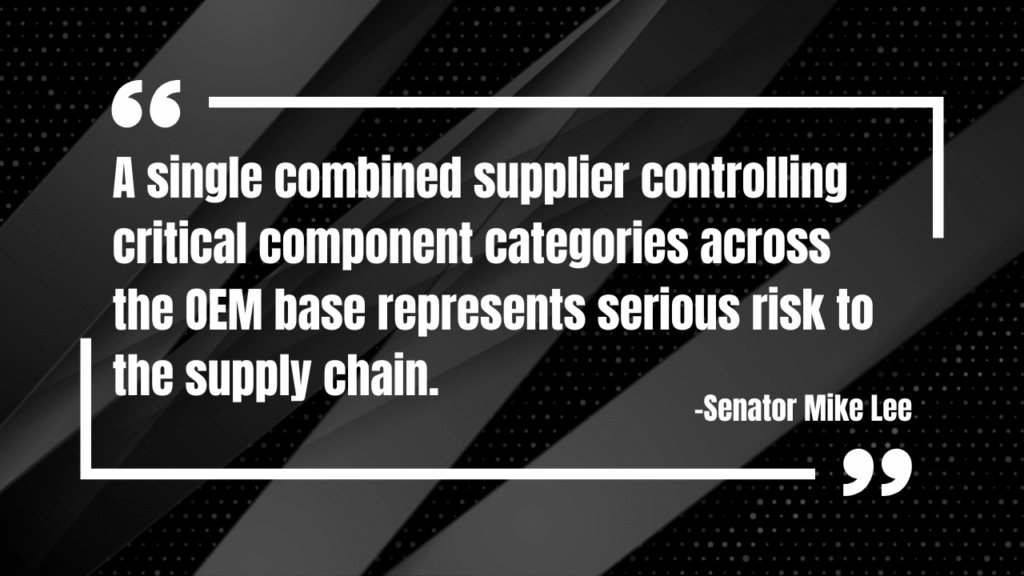
The merger had already drawn attention from U.S. Sen. Mike Lee of Utah, chairman of the Senate Judiciary Subcommittee on Antitrust, Competition Policy, and Consumer Rights. In April, Lee sent a letter to LCI and Patrick raising antitrust concerns about the companies’ then-publicly confirmed merger discussions and demanding documents, data, and answers to several questions related to the potential merger.
In that letter, Lee warned that a combined company could create “a supplier of considerable scale across multiple component categories critical to RV manufacturers,” and said the deal deserved close scrutiny. His concerns centered on pricing power, reduced competition, innovation, and supply chain resilience.
Those concerns are more relevant now that the companies have moved from discussions to a definitive agreement. Lee’s earlier letter also puts additional public pressure on the deal as it heads toward federal antitrust review.
Regulators are likely to look not only at the companies’ overall size but also at specific product categories where their portfolios overlap. In antitrust review, the question is often not whether a merged company is large overall, but whether customers would still have meaningful alternatives in particular markets.
What the Companies Say
Patrick and Lippert argue the merger will create a stronger, more efficient company with broader capabilities and better service for manufacturers and consumers. Patrick CEO Andy Nemeth said the deal would create a “premier partnership-oriented platform.” Lippert interim CEO Johnny Sirpilla said the combined company could offer a “broader, more innovative, competitive, and affordable portfolio.” The combined company is expected to have about $8.1 billion in trailing twelve-month revenue as of March 2026, and free cash flow of $508 million. The companies also say the merger should generate more than $150 million in annual cost savings within three years of closing.
The Case For — and Against — the Merger
The concern is whether those benefits will actually flow through to RV manufacturers and consumers — or primarily to shareholders. In theory, a larger supplier could reduce duplication, improve purchasing efficiency, enhance logistics, and lower costs for OEMs. That is the most favorable view of the merger. A more efficient supplier could help manufacturers manage costs, a challenge the RV industry faces amid affordability concerns.
But the opposite outcome is also possible.
If one supplier group controls too many critical components, manufacturers may have less ability to negotiate, less flexibility to switch suppliers, and less protection when prices rise or delivery problems occur. RV manufacturing giant Thor Industries makes more than 40% of all RVs sold in North America, and has hedged its exposure to Lippert/Patrick through its own supplier brand, Airxcel, which it acquired in 2021. But smaller RV manufacturers could be especially vulnerable to the merger’s effects, as they often lack the purchasing leverage of large OEMs like Thor.
RV buyers often experience supply chain issues long after the transaction is complete. Parts costs affect MSRP. Supplier quality affects warranty claims. Component availability affects repair times. Innovation, or the lack of it, affects whether RVs improve or simply become more expensive.
A combined Lippert-Patrick could have enormous influence over everything from structural components and interiors to aftermarket parts and accessories.
RVs are complex products assembled from thousands of components sourced from outside suppliers. When competition is healthy, manufacturers can shop for better pricing, better quality, faster delivery, and new ideas. When supplier options narrow, that pressure can weaken.
That is the central concern with this merger: not that a large supplier is automatically bad, but that a supplier this large could become too important for manufacturers to realistically avoid.
Leadership and Timing
The merger also comes shortly after a major leadership change at Lippert. On June 4, LCI Industries announced that Jason Lippert had retired and stepped down as president and CEO, effective immediately, and former Camping World executive and LCI board member Johnny Sirpilla was appointed interim CEO.
Whether Jason Lippert’s departure is connected to the revived merger agreement is unknown. But the timing is notable. In the new merger structure, Patrick CEO Andy Nemeth will lead the combined company. Patrick director Todd Cleveland will serve as board chair, and Sirpilla will serve as vice chair. The board will have 12 directors, with six designated by Patrick and six by Lippert. The combined company will remain headquartered in Elkhart, Indiana.
Patrick shareholders will hold the slightly larger ownership stake. When the transaction is complete, Patrick shareholders are expected to own about 52% of the combined company, while LCI shareholders will own about 48%. The deal is expected to close in the first half of 2027, pending shareholder approval, regulatory approval, and other closing conditions. A release did not indicate what the combined company’s name or stock ticker will be, but the names of the many individual brands in their portfolio will likely remain intact.
Given the concerns already raised by Senator Lee, the deal is likely to face at least some antitrust scrutiny before it moves forward.
For manufacturers, the concern is leverage. For RV buyers, the concern is cost, quality, and choice. For regulators, the question will be whether the combined company would have too much control over too many critical parts of the RV supply chain.
Patrick and Lippert say the merger will create a stronger, more innovative, more efficient company. That may prove true.
But the RV industry has reason to be cautious. When two of the largest consolidators in the RV supply chain become one, the potential benefits are obvious — but so are the risks.