Since debuting our Sabre 37RVMILES, we’ve been getting a lot of questions about fifth wheel pin weight and whether certain trucks can tow our new rig. And in those questions, we’re noticing something pretty common: confusion about pin weight, and how it relates to what your truck can safely tow.
If you’re new to fifth wheels—or even if you’ve been towing for years—understanding pin weight is one of the most important things you can do to stay within your truck’s limits and tow safely. Let’s break down what pin weight is, why it matters, and how to estimate it when matching a fifth wheel with a tow vehicle.
Pin weight is the downward force a fifth wheel trailer places on the hitch in the bed of a truck. Typically, fifth wheel pin weight equals 15–20% of the trailer’s total loaded weight and counts against the truck’s payload capacity. Understanding pin weight is essential when matching a fifth wheel with a tow vehicle to ensure safe and legal towing.
Prefer to watch instead?
Pin Weight vs. Tongue Weight
If you’re coming from a travel trailer, you’re probably familiar with tongue weight.
A conventional travel trailer attaches to a ball hitch behind your vehicle’s bumper. Most of the trailer’s weight rides on the trailer’s own axles, and only about 10% of the trailer’s weight transfers to the tow vehicle. That downward pressure is called tongue weight.
A fifth wheel, however, connects differently.
Instead of hitching behind the bumper, a fifth wheel uses a kingpin that connects to a hitch in the bed of the truck, positioned directly over the rear axle. This design offers several advantages:
- Improved towing stability with almost no sway
- Better weight distribution
- A slightly shorter overall towing length compared to a travel trailer of the same size
But because of this design, more of the trailer’s weight transfers to the truck, which is where pin weight comes in.
The Two Forces of Towing
When towing an RV, two main forces come into play:
Horizontal Force
This is the force required to pull the trailer down the road. It determines your truck’s tow rating.
Vertical Force
This is the downward weight placed on the truck’s axles, suspension, and tires. It determines your truck’s payload rating.
Pin weight affects the vertical force, which means it primarily impacts your payload capacity, not just your towing capacity.
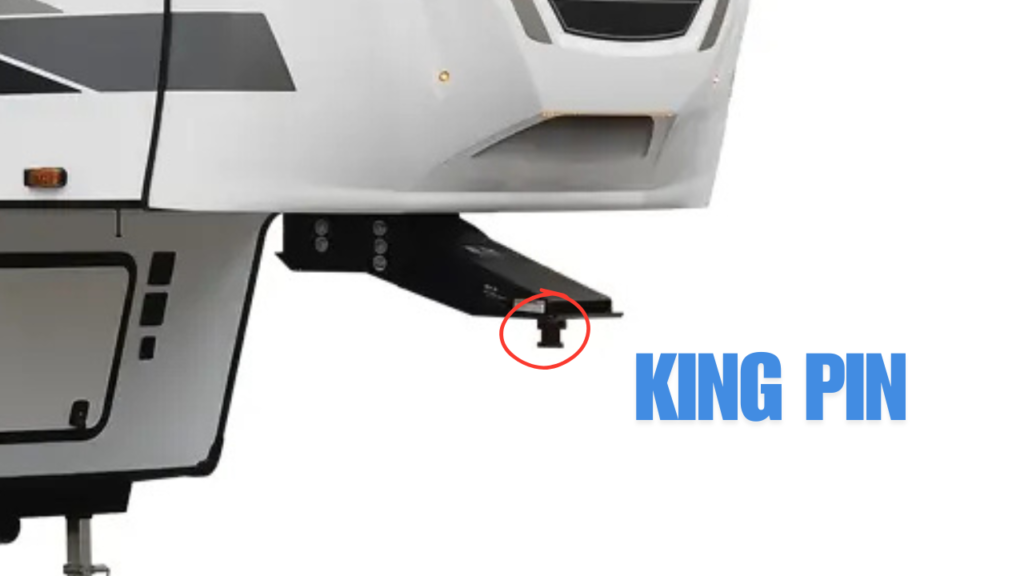
What Is a Kingpin?
The kingpin is the steel pin located under the front overhang of a fifth wheel. It connects the trailer to the fifth wheel hitch mounted in the truck bed.
The pin weight is the amount of vertical load pushing down on that kingpin and into your truck.
When figuring out if your truck can handle a fifth wheel, pin weight is often the limiting factor, because that weight must fit within your truck’s payload rating.
Understanding Fifth Wheel Weight Ratings
When you look at an RV manufacturer’s website, you’ll usually see two key numbers:
UVW (Unloaded Vehicle Weight)
This is the weight of the RV as it leaves the factory with no cargo.
Pin Weight or Hitch Weight
This is the amount of weight pressing down on the hitch when the trailer is empty.
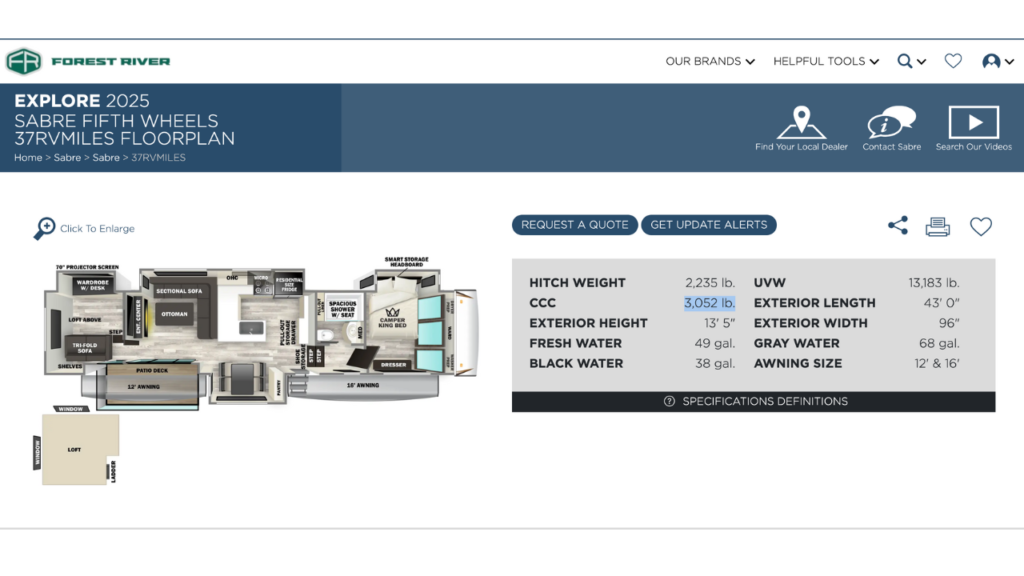
For example, the Sabre 37RVMILES has:
- UVW: 13,183 lbs
- Hitch Weight: 2,235 lbs
That’s about 17% of the trailer’s unloaded weight.
But here’s the key point: those numbers don’t include your cargo.
Food, gear, clothing, propane, water, tools, and everything else you bring will increase both the trailer’s weight and the pin weight.
Cargo Carrying Capacity and GVWR
Every RV also has a Cargo Carrying Capacity (CCC).
This is the amount of weight you can add to the trailer on top of the UVW.
When you add UVW + CCC, you get the trailer’s Gross Vehicle Weight Rating (GVWR).
GVWR represents the maximum allowable weight of the trailer when fully loaded.
This number is critical when estimating real-world pin weight.
Estimating Real Pin Weight
Fifth wheel manufacturers typically design their trailers so that:
15%–20% of the trailer’s total weight sits on the pin.
In the Sabre example:
- UVW: 13,183 lbs
- Hitch weight: 2,235 lbs (≈17%)
But if the trailer is loaded closer to its GVWR, the pin weight will increase.
A simple rule many experienced RVers use:
Estimate pin weight at about 20% of the trailer’s GVWR.
For example:
If the trailer GVWR is 16,235 lbs, then:
16,235 × 20% = 3,247 lbs estimated pin weight
And depending on how the trailer is loaded, it could be even higher—especially if storage compartments, kitchens, or tanks are located forward of the axles.
Other Important Truck Weight Ratings
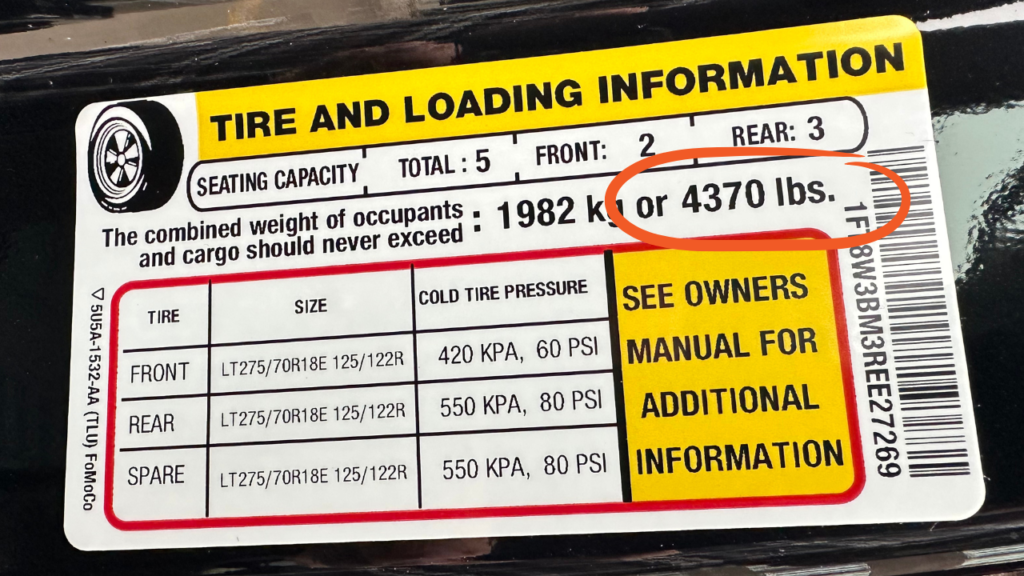
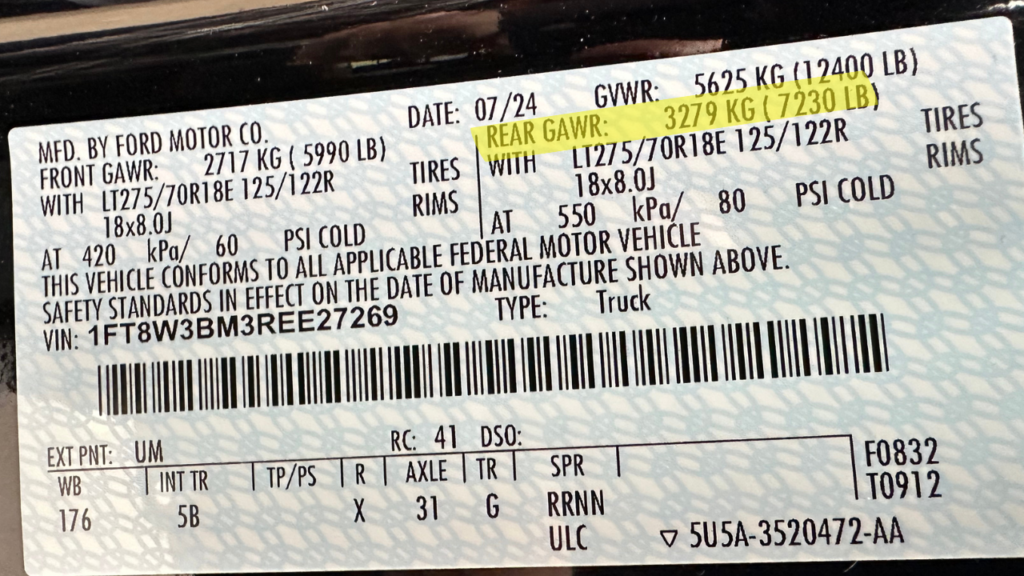
Beyond payload, you should also check:
Rear Axle Weight Rating (RAWR)
The maximum load allowed on the rear axle.
Tire Load Ratings
Ensure your tires can support the weight being carried.
Gross Combined Weight Rating (GCWR)
The maximum allowable combined weight of the truck and trailer.
Weighing Your Truck and Trailer
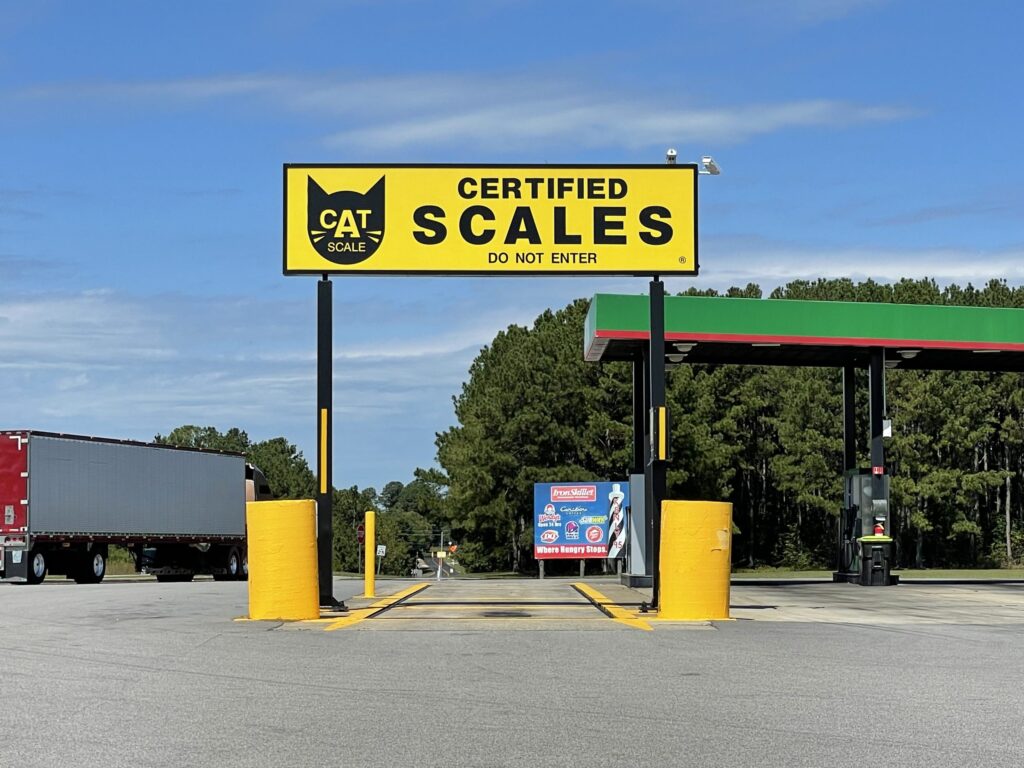
The best way to confirm your setup is safe is by weighing your rig on a CAT scale.
You’ll find these at many truck stops.
Here’s how it works:
- Pull onto the scale with:
- Front axle on one pad
- Rear axle on another
- Trailer axles on the third
- The scale records:
- Steer axle weight
- Drive axle weight
- Trailer axle weight
- Then disconnect the trailer and weigh the truck alone.
By comparing the numbers, you can determine:
- Actual pin weight
- Total trailer weight
- Weight distribution across axles
This helps ensure you’re within limits for:
- GVWR
- GCWR
- Axle ratings
- Payload
Final Thoughts on Pin Weight and Safe Towing
When matching a truck with a fifth wheel, don’t cut it close.
Estimating pin weight at 20% of GVWR, leaving room in your payload rating, and verifying everything on a scale will make for a safer, more comfortable towing experience.
Even if your truck is technically within its limits, having a little extra margin reduces stress on your suspension, improves handling, and helps your RV ride better on the road.
In short: estimate, leave a cushion, and verify on a scale. Before hitting the road, make sure you’re also familiar with our RV driving tips and fuel-saving tips.
Happy towing.

Looking for real, fact-based journalism presented by real people who actually RV? Frustrated with the amount of AI slop and disinformation taking over the RV space, profiting off RV consumers who are frustrated and afraid of making a wrong decision?
Help us fight back against the growing amount of clickbait trash growing on YouTube and all across social media by becoming a Mile Marker member and supporting the work we do at RV Miles. From the website to newsletters to videos, podcasts, and so much more, we are working to create a network of content that is unbiased and values quality over quantity. Help make that happen. Click below to join for as little as $7 a month. Thank you!